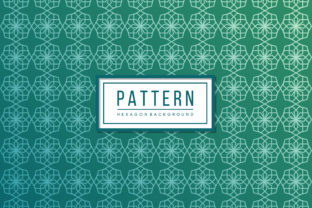
Hexagon Islamic Pattern Gradient Green: A Timeless Symbol of Harmony in Design and Spirit
The Hexagon Islamic Pattern Gradient Green is far more than a decorative motif—it is a convergence of mathematics, faith, and visual language that has resonated across centuries and continents. Rooted in the precision of Islamic geometric art, this design centers the hexagon—the foundational shape that naturally tessellates without gaps—infused with a fluid, layered green gradient evoking growth, serenity, and divine mercy. Its presence in architecture, digital interfaces, textile design, and seasonal observances like Ramadan Kareem reflects a deep cultural continuity: one where geometry becomes devotion, and color becomes meaning.
Why the Hexagon? Geometry as Sacred Language
In Islamic artistic tradition, the hexagon is not chosen arbitrarily. It emerges organically from the circle—a symbol of unity and the infinite—and divides cleanly into six equilateral triangles, each angle measuring exactly 60 degrees. This inherent symmetry allows for seamless repetition across surfaces, embodying the Islamic principle of tawhid: the oneness and order of creation. Unlike representational imagery, geometric patterns avoid idolatry while inviting contemplation. The hexagon’s ability to interlock perfectly—forming stars, rosettes, and interlaced bands—makes it ideal for expressing complexity without chaos.
When rendered in a Hexagon Islamic Pattern Gradient Green, the shape gains additional resonance. Green holds profound significance in Islamic tradition: it appears in descriptions of Paradise in the Qur’an, adorns the Prophet Muhammad’s cloak in historical accounts, and is widely associated with life, renewal, and spiritual vitality. A gradient—from sage to emerald, or mint to deep forest—adds dimensionality and movement, transforming static repetition into a living rhythm. This subtle shift in tone mimics natural phenomena: light filtering through palm fronds, the changing hue of leaves at dawn, or the layered depth of a mosque’s stained-glass window.
From Mosque Walls to Modern Interfaces: Practical Applications
The adaptability of the Hexagon Islamic Pattern Gradient Green makes it uniquely suited to diverse real-world contexts—not as mere ornament, but as functional design language.
- Architectural Integration: In contemporary mosque renovations and Islamic cultural centers, this pattern appears in laser-cut metal screens (mashrabiya), ceramic tilework, and illuminated ceiling panels. Its modularity allows architects to scale it precisely—covering a 3-meter prayer niche or wrapping an entire façade—while maintaining visual coherence. A recent project in Amman used a custom Hexagon Islamic Pattern Gradient Green in terracotta cladding, where the gradient responded dynamically to shifting sunlight throughout the day.
- Digital Experiences: Web designers and app developers increasingly deploy this motif as subtle background textures or loading animations—especially for platforms serving Muslim audiences during Ramadan. Rather than overt religious iconography, the Hexagon Islamic Pattern Gradient Green offers cultural grounding through abstraction. One educational platform for Quranic studies uses animated hexagonal transitions between lessons, with the green gradient intensifying slightly at moments of reflection or recitation—leveraging color psychology without prescription.
- Textiles and Product Design: From modest fashion labels in Kuala Lumpur to sustainable home goods studios in Istanbul, the pattern informs jacquard weaves, embroidery motifs, and ceramic glazes. Because the hexagon grid aligns seamlessly with fabric grain and print repeats, it minimizes waste in production—a practical advantage often overlooked. Designers note that the gradient softens the pattern’s formality, making it suitable for children’s wear or wellness branding where warmth matters as much as tradition.
- Ramadan Kareem Visual Identity: During the holy month, brands and community organizations use variations of this pattern in invitations, social media banners, and iftar packaging. Crucially, its non-figurative nature ensures broad acceptance across sects and schools of thought. A London-based food co-op prints reusable cloth bags with a low-opacity Hexagon Islamic Pattern Gradient Green overlay—functional, eco-conscious, and quietly reverent.
Advantages Beyond Aesthetics
What distinguishes the Hexagon Islamic Pattern Gradient Green from trend-driven visuals is its layered utility:
Scalability without distortion: Unlike organic motifs or typography-based designs, the hexagonal grid maintains integrity whether reduced to a 16×16 pixel favicon or enlarged to cover a 50-meter wall. Vector-based implementations require minimal file size, supporting fast-loading websites and accessible digital tools.
Cultural resonance without exclusivity: While deeply rooted in Islamic heritage, the pattern’s mathematical basis gives it universal appeal. Educators use it to teach tessellation in geometry classes; neuroscientists study its effect on visual relaxation; interior designers select it for healthcare spaces due to green’s documented calming effect on heart rate variability. Its strength lies in being both specific and inclusive.
Adaptability to material constraints: Whether etched into aluminum, woven into bamboo fiber, printed on biodegradable paper, or projected as light art, the Hexagon Islamic Pattern Gradient Green translates faithfully. The gradient can be simulated through halftone screening for monochrome printing or simplified to two-tone for embroidery limitations—retaining recognizability without demanding technical perfection.
Considerations for Thoughtful Implementation
Despite its versatility, deploying the Hexagon Islamic Pattern Gradient Green demands intention—not just aesthetics. Here are key considerations observed across professional practice:
- Color fidelity matters: “Green” spans thousands of hues, and cultural associations vary. In South Asian contexts, brighter, jewel-toned greens may evoke celebration; in North African traditions, muted olive or khaki gradients reflect earth and endurance. Always test palettes with representative users—not just designers—especially when designing for multilingual or multi-regional audiences.
- Context determines contrast: A high-opacity gradient may overwhelm text in a mobile app interface, while too-light a version may vanish on glossy print stock. Best practice: maintain at least 4.5:1 contrast ratio against adjacent content, verified with accessibility tools—not visual estimation.
- Avoid flattening meaning: Using the pattern solely as “exotic texture” risks reducing sacred geometry to superficial styling. When adopted by non-Muslim creators or global brands, pairing it with accurate attribution, contextual education (e.g., brief notes on its mathematical origins), or collaboration with Muslim artists strengthens integrity.
- Respect spatial hierarchy: In architectural applications, the pattern should enhance—not compete with—structural elements. A common misstep is overloading archways or mihrabs with dense repetition, which can visually compress space. Strategic negative space around the hexagons preserves breathability and reverence.
Observations from Field Practice
Over years of documenting design implementation—from artisan workshops in Fez to UX teams in Dubai—certain patterns emerge. First, the most enduring uses treat the Hexagon Islamic Pattern Gradient Green as a *system*, not a static image. For example, a Cairo-based publisher developed a modular design kit where hexagons serve as containers for quotes, verses, or illustrations—each sized and spaced according to typographic hierarchy, with the gradient subtly adjusted to signal emphasis.
Second, educators report heightened engagement when students generate their own hexagonal grids using compass-and-straightedge methods before digitizing them. This bridges abstract math, cultural history, and hands-on creativity—making the pattern a pedagogical anchor rather than decoration.
Third, sustainability practitioners highlight how the pattern’s efficiency supports eco-design goals. Because its repeat unit is compact and predictable, digital printers reduce ink usage by up to 18% compared to irregular floral motifs—and physical tile manufacturers cut material waste by optimizing hexagonal cutting paths.
Looking Ahead: Tradition in Motion
The Hexagon Islamic Pattern Gradient Green continues to evolve—not by abandoning its roots, but by absorbing new contexts. Generative design tools now allow real-time modulation of the gradient based on ambient light or user interaction. Augmented reality apps overlay animated hexagonal lattices onto historic sites, revealing hidden symmetries beneath centuries-old plasterwork. Meanwhile, climate-conscious architects are exploring bio-responsive versions: hexagonal façade panels whose green gradient shifts with temperature, signaling energy efficiency metrics to passersby.
Its endurance lies in balance: mathematical rigor and poetic softness, tradition and innovation, stillness and flow. When you see the Hexagon Islamic Pattern Gradient Green—whether framing a Ramadan Kareem greeting, lining the edge of a textbook on symmetry, or glowing softly behind a meditation app—it does more than decorate. It invites pause. It affirms order. It whispers, across time and discipline, that beauty, meaning, and function need not compete—they tessellate.