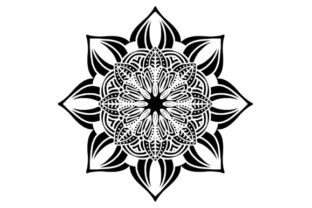
Mandala Vector Art Pattern 820: Precision, Flexibility, and Real-World Use
When you search for a mandala design that balances intricate symmetry with clean scalability—especially one ready for print, web, or product development—Mandala Vector Art Pattern 820 stands out. It’s not just another decorative motif. This pattern delivers professional-grade geometry in three essential formats: AI (Adobe Illustrator), EPS (cross-compatible vector), and JPG (high-res raster). That trifecta matters more than many realize—especially if you’re designing merch, creating lesson materials, building brand assets, or preparing files for a print vendor.
Why This Pattern Fits So Many Real Needs
Unlike hand-drawn or low-res mandalas, Mandala Vector Art Pattern 820 is mathematically precise—every curve, repeat, and radial element aligns flawlessly. That means it scales from a business card to a 6-foot wall mural without pixelation or distortion. Educators use it in mindfulness worksheets; small business owners integrate it into packaging or social media banners; freelancers embed it into client branding kits. Its balanced complexity—detailed enough to feel intentional, but not so dense it overwhelms—makes it unusually versatile.
A Common Misstep: Assuming “Vector” Means “Ready for Everything”
Here’s where things go sideways: people download the AI or EPS file and assume it’s plug-and-play for any project. Not quite. AI files require Adobe Illustrator (or compatible software). If you only have Canva, Affinity Designer, or free tools like Inkscape, the AI version may not open—or worse, open with missing layers, misaligned paths, or embedded fonts that don’t render. Similarly, EPS files are widely supported, but older versions (like EPS 8 or earlier) can behave unpredictably in modern apps unless saved with compatibility settings enabled.
Example: A yoga studio owner bought Mandala Vector Art Pattern 820 to update their class schedule posters. She opened the AI file in Canva, saw garbled shapes, assumed the file was corrupted—and nearly requested a refund. In reality, she needed the EPS version, which imported cleanly into her desktop publishing tool. The fix? Knowing which format matches your workflow—not just which one sounds most “professional.”
Overlooking Color Mode and Output Intent
Another frequent oversight: using the same file for both digital screens and physical print without checking color mode. Mandala Vector Art Pattern 820 typically ships in RGB (ideal for websites, presentations, social posts) and sometimes includes a CMYK variant (required for offset or screen printing). If you send an RGB file to a print shop for t-shirt transfers, colors may shift dramatically—blues turn purple, blacks look muddy. That doesn’t mean the pattern is flawed; it means color management wasn’t part of the plan.
Better approach: Before finalizing, ask yourself: Where will this live? If it’s for Instagram or a PDF brochure, RGB is fine. If it’s going on fabric, stationery, or signage, request or convert to CMYK—and soft-proof it using your printer’s ICC profile if possible.
Underestimating Layer Organization—and Why It Matters
This pattern includes layered construction: outer rings, central motif, connecting elements, and background shapes—each on its own layer. That’s a huge advantage… if you know how to use it. Beginners often merge or flatten layers unintentionally, losing the ability to recolor individual components or isolate parts for animation or cut-file preparation (e.g., for Cricut or Silhouette machines).
Tip: In Illustrator, double-click the layer name to rename it (e.g., “Outer Petals,” “Center Dot,” “Background Circle”). Lock layers you’re not editing. Use the Isolation Mode (double-click a group) to focus on one section without affecting others. That simple habit saves hours when customizing for different clients or applications.
The JPG File Isn’t Just a Backup—It Has Its Own Role
Some users ignore the JPG entirely, thinking “vector = better, always.” But the high-resolution JPG (often 300 DPI at 5000×5000 px or larger) serves distinct purposes: embedding directly into PowerPoint or Google Slides, uploading to platforms that don’t accept vector uploads (like some LMS dashboards or email builders), or using as a texture overlay in photo editing. Because it’s pre-rendered, it loads faster than vector in web contexts where SVG isn’t supported or optimized.
Just remember: never scale the JPG up beyond 100% in layout software. Enlarging it introduces blur and aliasing. Use it at native size—or better yet, choose the vector version when scaling flexibility is needed.
What to Check Before You Download or Buy
Before committing—even if it’s a low-cost or subscription-based download—verify these five points:
- File naming consistency: Does “Mandala Vector Art Pattern 820” appear clearly in each filename (e.g., mandala-pattern-820.ai)? Mislabeled files cause confusion later, especially when managing dozens of assets.
- Version notes: Is there a changelog or version date? Reputable creators update files for software compatibility—say, adding support for Illustrator 2024’s new export options or fixing a minor anchor point issue.
- License clarity: Does the license permit commercial use? Modifications? Reselling as part of a template? Most include standard extended licenses, but verify—especially if you’re bundling it into a Canva template pack or selling printable planners.
- Preview accuracy: Compare the thumbnail or mockup with the actual vector file. Some previews add shadows, textures, or background colors not present in the raw file. What you see isn’t always what you get—unless the preview is a direct screenshot of the Illustrator artboard.
- Support responsiveness: Is there a clear way to ask a quick question? A well-maintained Mandala Vector Art Pattern 820 listing usually includes a short FAQ or contact link—not just a generic “contact us” page.
One Last Practical Note: Test Early, Scale Thoughtfully
Don’t wait until the final hour to test Mandala Vector Art Pattern 820 in your intended environment. Try opening the EPS in your layout app. Drop the JPG into your email campaign builder. Import the AI into your animation software and check path smoothness. If something feels off—a jagged edge, unexpected transparency, or font substitution—it’s almost always fixable, but much easier to resolve before the deadline.
And remember: elegance in mandala design comes from restraint as much as detail. You don’t need to use every layer or every color variation. Sometimes, removing two outer rings and shifting the hue to match your brand palette creates a stronger impression than using the full pattern as-is. Mandala Vector Art Pattern 820 gives you that freedom—because it’s built for adaptation, not just decoration.